

If you have been researching herniated discs late at night, you have probably run into the term “spinal decompression.” Maybe a friend mentioned it. Maybe it came up after an MRI. But 4D spinal decompression is a different thing, and for anyone dealing with chronic back pain, sciatica, or a disc problem that has not responded to anything else, that difference is the whole story.
Here is what it is, how it works, and why the technology behind it changes what is possible for your spine.
Your Spine Doesn't Move in a Straight Line
Think about an ordinary morning. You twist to grab your coffee. You bend to tie a shoe. You shift your weight a hundred times without ever noticing. Your spine works in several directions at once, all day long.
Old-school traction never accounted for that. It pulled the spine straight up, one direction, the same force and the same angle for every person on the table. A small frame and a large frame, a fresh injury and a decade-old one, all treated the same way. That is the reason so many people got a few good days from traction and then watched the pain come straight back. You cannot fully treat a structure that moves in three dimensions by pulling it in one.
4D decompression was built to fix exactly that gap.
What the 4 Dimensions Actually Do
The “4D” is not a marketing label. It refers to four real mechanical axes the table can move through, and each one earns its place.
Axial Decompression
The first is axial decompression. This is the lengthwise separation between vertebrae, the gentle creation of space that lowers pressure inside the disc and gives a compressed nerve root room to settle. It is the foundation the other three build on.
Lateral Movement
Then there is lateral movement, side to side. Plenty of disc problems are not centered. The bulge leans to one side, or years of uneven loading have pulled the pelvis out of balance. A standard table cannot reach that. A table that shifts laterally can.
Rotation
Rotation adds gentle, controlled torsion. Here is why that matters: almost nobody injures a disc while sitting in a perfectly straight, neutral posture. Real injuries happen mid-twist, mid-reach, mid-lift. Years of rotational habits leave the disc needing care from the angle it was actually hurt, not from some idealized textbook position.
Trunk flexion and extension
The fourth is trunk flexion and extension, the forward and backward tilt of the pelvis and trunk. For targeting a specific part of a disc, this is the one that changes everything. Your herniation has a location. It might sit toward the back of the disc, or off in one quadrant your MRI already pinpointed. Adjusting this angle lets the treatment follow your pathology instead of guessing at it.
Put those four together and something becomes clear. Two people can walk in with the same L5-S1 herniation written on the same MRI report and still need completely different treatment. 4D decompression is built to treat the person, not the diagnosis on paper.
If you are in Burlington, Oakville, Hamilton, or Milton and you have been told your disc problem needs surgery, or that you will just have to live with it, it is worth seeing what this technology can do first.
We will show you where your problem actually sits and what a plan built for your spine looks like.
The Feedback System That Keeps It Safe
The four dimensions get the attention, but the part that genuinely separates 4D decompression from everything before it is quieter. It is the sensor system built into the table.
Pressure sensors and load monitors read what your body is doing moment to moment. If a muscle tightens, if your spine starts to brace, if any resistance shows up at all, the system feels it and responds. It slows down, backs off, or pauses completely until your body relaxes again. The table never fights you. It waits for the spine to release, then it continues.
That is why most patients describe a session as comfortable, even relaxing. Some settle in. A few fall asleep. The technology is designed to work with your body’s natural protective reflexes rather than push past them. And while the table handles the constant micro-adjustments on its own, a trained clinician watches every session. The technology controls the movement. The clinical judgment controls the plan. Both matter.
Why This Matters For Herniated Discs, Sciatica, And Stenosis
When a disc herniates, the soft inner material pushes through the tough outer wall and presses on a nearby nerve root. That pressure is the shooting leg pain, the numbness, the burning that turns a car seat into something you dread. Lower the pressure inside that disc, consistently and from the correct angle, and you create the conditions for the disc material to retract and the nerve to calm down.
That does not happen reliably when a table can only pull straight up. It happens when the treatment matches the real geometry of your spine, which is the entire point of a four-axis design. You can see the technology we use at the clinic on our technology page.
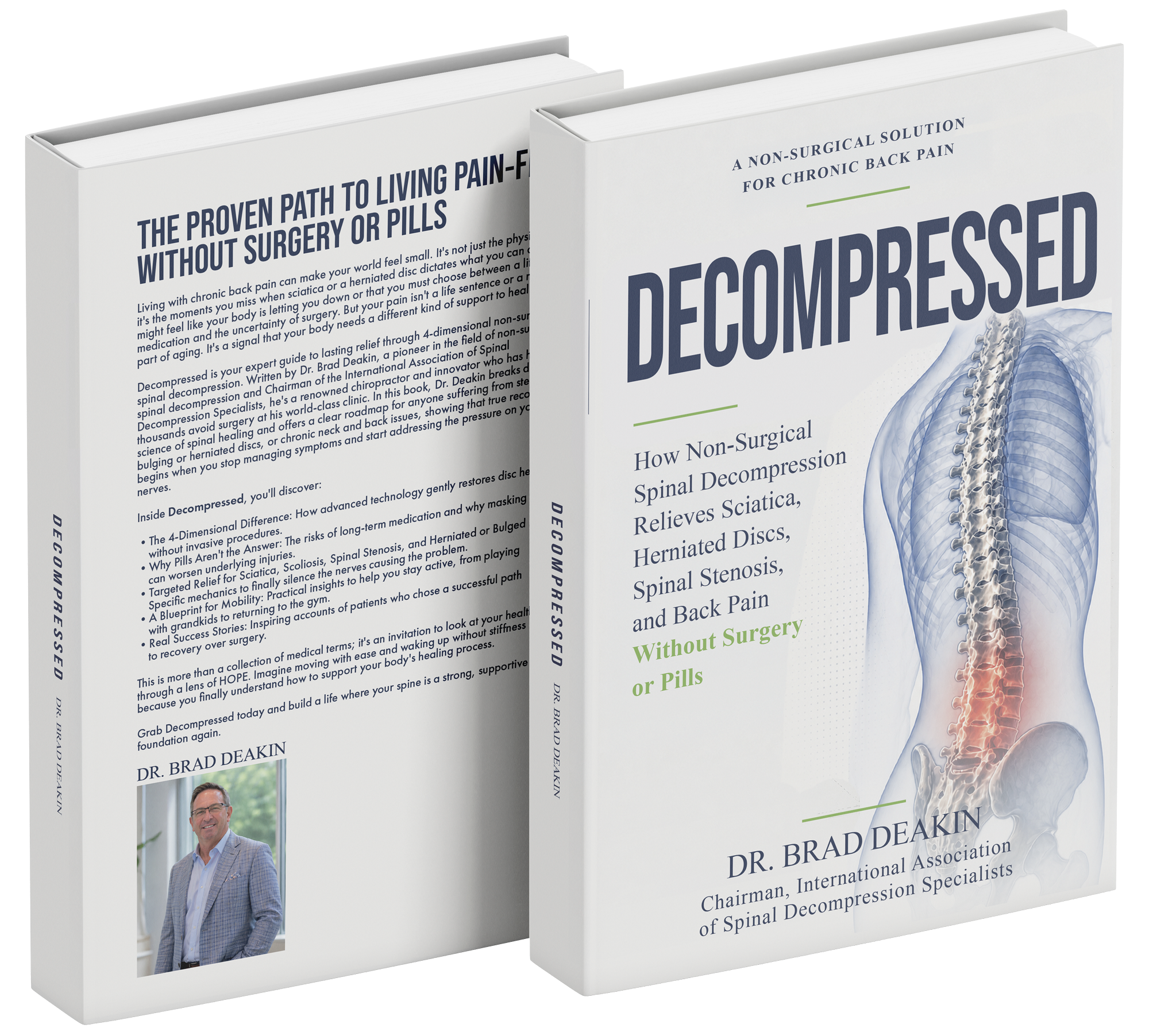
Dr. Brad Deakin devotes a full chapter of Decompressed to this story, tracing the path from basic traction to computer-guided systems to the multi-axis tables used now. If you want the deeper science and the history behind it, the book lays it all out.
What To Expect
A typical treatment session lasts 20 to 30 minutes. You’re on the table, and the robot uses a custom-built routine based on your disc level, the specific direction your herniation went, and how your body reacts during the session. All of that is based on what we see in your imaging and exam data.
We measure progress with follow-up scans and exams, and the goal isn’t simply to have you report lower pain levels for seven days. It’s good disc and nerve behavior, and a spinal support system that can maintain that.
Recommended Reading
Want to understand spinal decompression better?
Dr. Brad Deakin’s book Decompressed explains how non-surgical spinal decompression supports people dealing with sciatica, herniated discs, spinal stenosis, and disc-related back pain.
View the Book on AmazonFrequently Asked Questions
No. An inversion table uses your body weight for a passive stretch in one direction. 4D decompression uses computer-controlled movement across four axes with live sensor feedback to target one disc at one precise angle. They are not in the same category.
Most people find it comfortable. The feedback system stops the table from ever applying more force than your body accepts. There is no cracking, no twisting, no sudden movement.
4D spinal decompression may be recommended for people dealing with disc-related back or neck pain, sciatica, herniated discs, bulging discs, or spinal stenosis. During your consultation, we review your symptoms, history, and exam findings to see whether this approach is appropriate for your condition.
It depends on how severe the disc problem is, how long you have had it, and how your body responds. After your initial exam and report of findings, Dr. Deakin will walk you through a clear plan built for your condition.
It helps, but it is not required. If you already have imaging, bring it with you. If you do not, we will determine during the exam whether new imaging is needed before building your 4D spinal decompression plan.
For some patients, 4D spinal decompression may help reduce pressure around irritated discs or nerve areas that contribute to sciatica symptoms. The first step is an exam to understand what is causing the pain and whether spinal decompression is the right option.
Your first visit includes a consultation and examination to better understand your pain, mobility, and condition. If 4D spinal decompression is a good fit, we will explain your options and build a treatment plan based on your needs.
Chronic disc pain rarely responds to a generic, one-direction approach, because the spine was never a generic, one-direction structure. It is complex, it moves in every direction, and it needs treatment that respects that. That is what 4D decompression was designed to deliver.
Book your $99 initial exam today. Your visit includes a full consultation, nerve scans, digital X-rays, a review of your imaging, and a complete report of findings. No obligation to continue.
References
Apfel, C. C., Cakmakkaya, O. S., Martin, W., Richmond, C., Macario, A., George, E., Schaefer, M., & Pergolizzi, J. V. (2010). Restoration of disk height through non-surgical spinal decompression is associated with decreased discogenic low back pain: A retrospective cohort study. BMC Musculoskeletal Disorders, 11, 155. https://bmcmusculoskeletdisord.biomedcentral.com/articles/10.1186/1471-2474-11-155
Deakin, B. (2026). Decompressed: How non-surgical spinal decompression relieves sciatica, herniated discs, spinal stenosis, and back pain without surgery or pills. https://www.amazon.ca/dp/1835566790
Macario, A., & Pergolizzi, J. V. (2006). Systematic literature review of spinal decompression via motorized traction for chronic discogenic low back pain. Pain Practice, 6(3), 171-178. https://onlinelibrary.wiley.com/doi/10.1111/j.1533-2500.2006.00082.x
Gose, E. E., Naguszewski, W. K., & Naguszewski, R. K. (1998). Vertebral axial decompression therapy for pain associated with herniated or degenerated discs or facet syndrome: An outcome study. Neurological Research, 20(3), 186-190. https://pubmed.ncbi.nlm.nih.gov/9583579/

