
You noticed it in a photo first. One shoulder sitting higher than the other, or a slight lean when you were sure you were standing straight. Then came the ache low in your back after standing at the counter, the tightness on one side that ever quite lets go, and maybe a burn or numbness running down one leg when you walk to the mailbox.
For a lot of adults, that mix is the first real sign of scoliosis, a curve that has either been there quietly for years or has developed with age. And most people hear the same three words about it:
– “Just live with it”
There’s more to the story than that.
What Adult Scoliosis Actually Is
The curve itself usually isn’t what hurts. The pain comes from what it does to everything around it. When the spine leans to one side, the discs and joints on the inside of the curve carry more load than they were built for, so that side wears faster. As it wears, the channels the nerves travel through narrow, and the nerves get irritated.
Think of a car that’s slightly out of alignment. It still drives, but the tires on one side wear out years before the other. A curved spine does the same thing. One side takes the punishment, and that’s the side that sends pain, numbness, or a heavy feeling into the hip and leg.
It’s also why so many people tell us the pain is worse when they walk or stand and eases when they sit or lean on a grocery cart. Standing narrows those already-tight nerve channels. Leaning forward opens them back up.
Why a Curve Starts to Hurt
The curve itself usually isn’t what hurts. The pain comes from what it does to everything around it. When the spine leans to one side, the discs and joints on the inside of the curve carry more load than they were built for, so that side wears faster. As it wears, the channels the nerves travel through narrow, and the nerves get irritated.
Think of a car that’s slightly out of alignment. It still drives, but the tires on one side wear out years before the other. A curved spine does the same thing. One side takes the punishment, and that’s the side that sends pain, numbness, or a heavy feeling into the hip and leg.
It’s also why so many people tell us the pain is worse when they walk or stand and eases when they sit or lean on a grocery cart. Standing narrows those already-tight nerve channels. Leaning forward opens them back up.
If an adult curve has been limiting how you move, sit, or sleep, the first step is understanding what your spine is doing.
We will show you where your problem actually sits and what a plan built for your spine looks like.
“Just live with it” isn't a plan
It’s the absence of one. Managing a curve isn’t the same as ignoring it. There’s a real, conservative path for adult scoliosis that sits between doing nothing and major surgery, and it’s built around taking mechanical pressure off the spine. The goal isn’t a straighter X-ray. It’s calming the irritated structures, taking load off the worn side, and giving you back what the pain has been quietly taking.
How we approach a curve at Burlington Spinal Decompression
It starts with looking. Your initial exam maps exactly what your curve is doing: digital X-rays taken on site, an EMG nerve scan to see which nerves are under stress, and infrared thermography to read your nervous system. Then Dr. Brad Deakin walks you through every image, so you can see your own spine and where the curve is loading it.
Then decompression does what an adjustment or a stretch can’t. Gentle, computer-controlled traction creates space between the vertebrae the curve has been compressing. That space takes pressure off the discs and the nerves between them, and less pressure means less pain, numbness, and heaviness.
For a curved spine, one thing matters most. A standard table pulls in a straight line, as if the spine were flat. Yours isn’t. Our 4D technology adds lateral flexion and rotation, so we work along the direction of your curve instead of fighting it. Around that, we build your personalized physiotherapeutic plan, the strengthening and rehab that helps your muscles support the curve so the relief holds.
What progress looks like
It usually shows up in your day before it shows up on paper. Standing through a whole conversation without shifting your weight. Walking the dog to the end of the block without the leg lighting up. Getting through a round of golf or a Saturday pickleball game and still sleeping that night. We see it across Burlington and Halton every week: the Oakville walker, the Hamilton golfer, the Milton parent carrying kids on one hip. Most weren’t in an emergency. They’d managed a slow problem for years and finally wanted to know what was going on.
You don’t have to keep guessing, and you don’t have to accept that a curve is the end of the conversation.
Recommended Reading
Want to understand spinal decompression better?
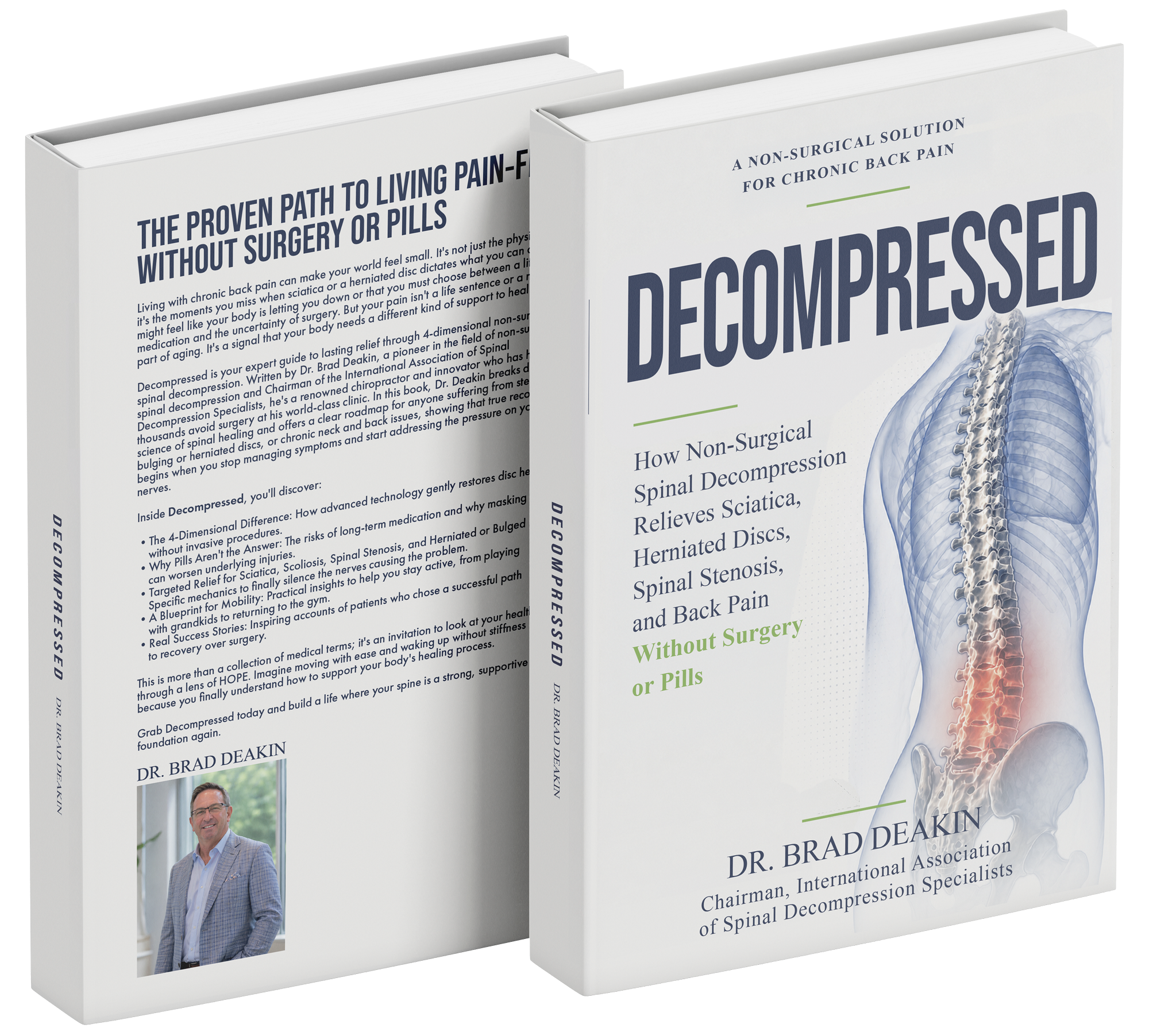
Dr. Brad Deakin’s book Decompressed explains how non-surgical spinal decompression supports people dealing with sciatica, herniated discs, spinal stenosis, and disc-related back pain.
View the Book on AmazonFrequently Asked Questions
No. Adult scoliosis can be treated at any age. The focus is relieving the pain the curve is causing, taking pressure off the worn side of the spine, and protecting your movement going forward. We set every part of care, including the force, angle, and speed of decompression, to your age and your spine.
Yes. Decompression creates space between compressed vertebrae and takes pressure off the discs and nerves along the curve. Our 4D technology adds lateral flexion, so it works along the direction of your curve instead of treating your spine as if it were straight.
No. Most people find it comfortable and relaxing. The traction is gentle and controlled, with no cracking or twisting. Many patients relax completely, and some fall asleep during a session.
No. We treat older adults regularly, and the technology lets us be as gentle as needed. Every setting is matched to your age, your bone health, and your comfort.
A full consultation, an EMG nerve scan, infrared thermography, digital X-rays, and a two-visit report of findings where Dr. Brad walks you through everything he sees in your spine. It’s regularly $300.
References
Adult degenerative scoliosis, prevalence and progression (AAPM&R, PM&R KnowledgeNow): https://now.aapmr.org/scoliosis/
Degenerative scoliosis: a review (HSS Journal, via NIH): https://pmc.ncbi.nlm.nih.gov/articles/PMC3192887/
Chronic disc pain rarely responds to a generic, one-direction approach, because the spine was never a generic, one-direction structure. It is complex, it moves in every direction, and it needs treatment that respects that. That is what 4D decompression was designed to deliver.
Book your $99 initial exam today. Your visit includes a full consultation, nerve scans, digital X-rays, a review of your imaging, and a complete report of findings. No obligation to continue.
Serving Burlington, Oakville, Hamilton, Milton, Waterdown, and the Halton region.
References
Apfel, C. C., Cakmakkaya, O. S., Martin, W., Richmond, C., Macario, A., George, E., Schaefer, M., & Pergolizzi, J. V. (2010). Restoration of disk height through non-surgical spinal decompression is associated with decreased discogenic low back pain: A retrospective cohort study. BMC Musculoskeletal Disorders, 11, 155. https://bmcmusculoskeletdisord.biomedcentral.com/articles/10.1186/1471-2474-11-155
Deakin, B. (2026). Decompressed: How non-surgical spinal decompression relieves sciatica, herniated discs, spinal stenosis, and back pain without surgery or pills. https://www.amazon.ca/dp/1835566790
Macario, A., & Pergolizzi, J. V. (2006). Systematic literature review of spinal decompression via motorized traction for chronic discogenic low back pain. Pain Practice, 6(3), 171-178. https://onlinelibrary.wiley.com/doi/10.1111/j.1533-2500.2006.00082.x
Gose, E. E., Naguszewski, W. K., & Naguszewski, R. K. (1998). Vertebral axial decompression therapy for pain associated with herniated or degenerated discs or facet syndrome: An outcome study. Neurological Research, 20(3), 186-190. https://pubmed.ncbi.nlm.nih.gov/9583579/

