

You spend about a third of your life on your mattress. So when your back is the first thing you notice in the morning, it is fair to wonder whether the thing you have been lying on for the last decade is part of the problem.
It is one of the questions we hear most often at our Burlington clinic. Patients come in from Burlington, Oakville, Hamilton and Milton and, somewhere in the conversation, almost all of them ask some version of it. What mattress should I buy? Firm or soft? Is memory foam better? Is my old one making this worse?
Here is the honest answer, and then the useful one. There is no single mattress that is best for every spine. But there is a clear set of things worth looking for, and once you know them you can walk into any store and test a mattress properly instead of guessing. This guide gives you both.
Still waking up in pain after changing everything? Book a $99 spinal assessment.
Is there really a best mattress for back pain?
Not one specific model, no. What the research points to is a firmness range, not a product.
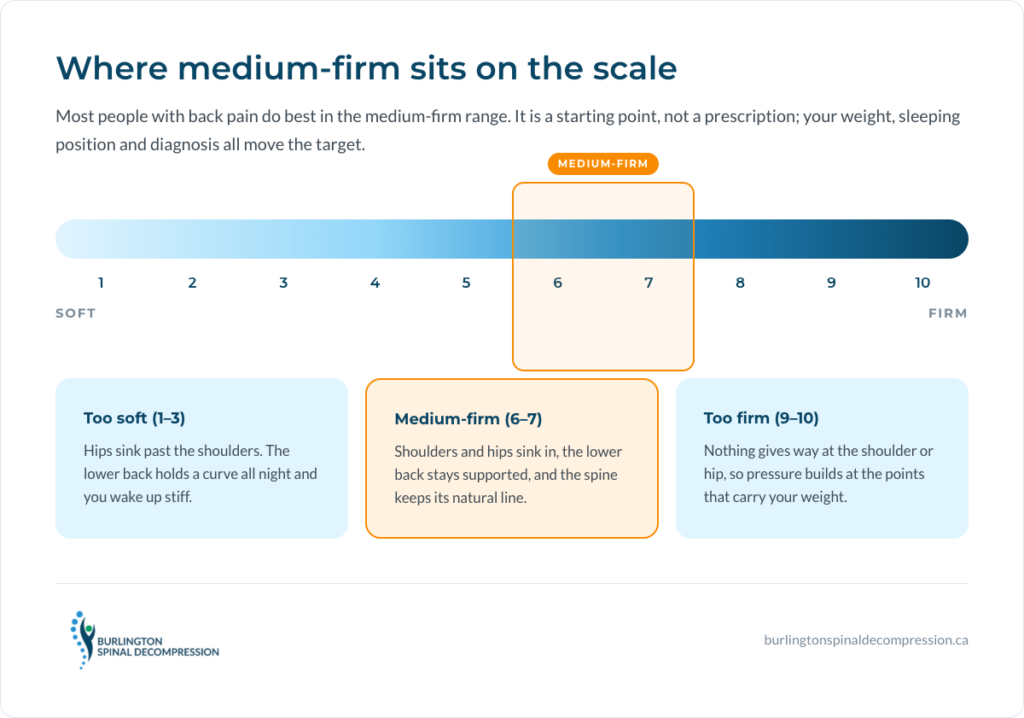
For years the standard advice was that a firm mattress is best for a bad back. That advice turned out to be wrong for most people. A large randomized controlled trial published in The Lancet followed 313 adults with chronic low back pain for 90 days and found that those sleeping on a medium-firm mattress reported better pain and less disability than those on a firm one. Later reviews of the research reached the same conclusion: for most people with ongoing low back pain, medium-firm is the better starting point, not the firmest thing on the floor.
A few honest caveats, because this is your spine and not a marketing pitch. That landmark trial is more than twenty years old. It used a European firmness scale that does not map neatly onto the soft-to-firm labels stores use today. And it measured group averages, which means the best surface for you as an individual still comes down to your body, your position and how the mattress actually feels when you lie on it. The research gives you a direction. It does not give you a serial number.
Is a firm or soft mattress better for back pain?
Short answer: for most people with chronic low back pain, a medium-firm mattress works better than a very firm one. Research has repeatedly found that medium-firm surfaces support the spine while still cushioning the hips and shoulders. Very firm and very soft surfaces both tend to perform worse, though personal comfort and sleeping position still matter.
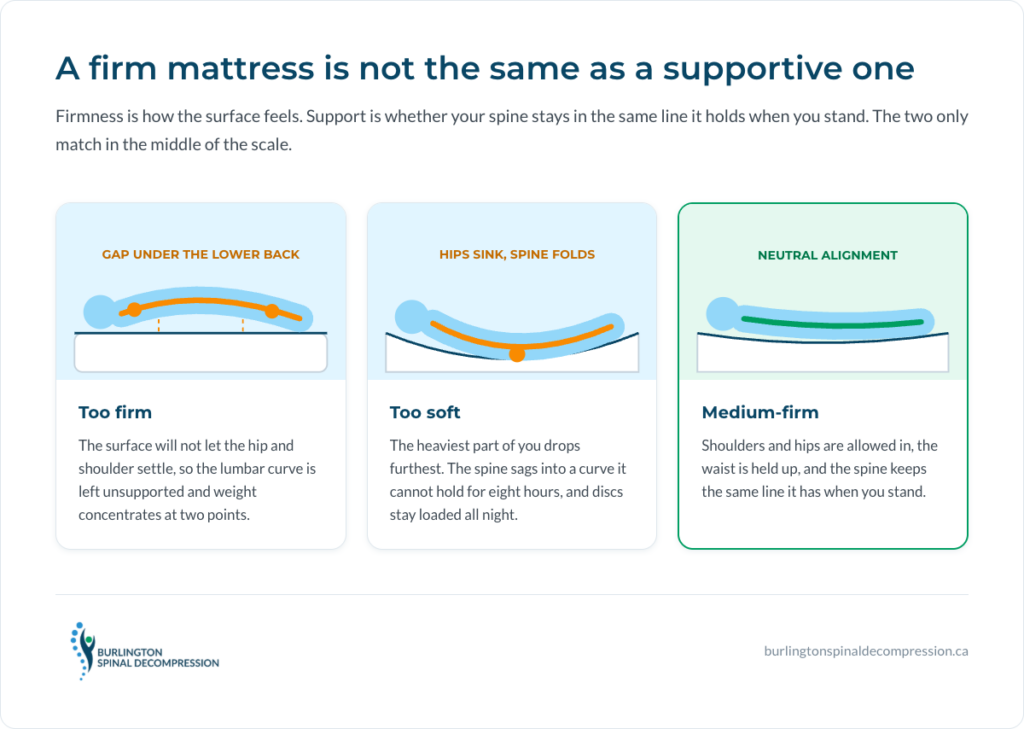
The reason medium-firm tends to win comes down to what your body does when it settles onto the surface. A mattress that is too firm does not give at the hips and shoulders, so those points carry your weight and your lower back is left bridging a small gap the mattress will not fill. A mattress that is too soft lets your hips sink lower than your shoulders, which drops your spine into a sag all night.
This is also where two ideas get confused, so it is worth separating them.
Support and firmness are not the same thing
Firmness is how hard the surface feels when you first lie down. Support is whether the mattress holds your spine in a comfortable, roughly neutral position through the night. They are related, but they are not the same.
A soft mattress can still be supportive if it contours to you and keeps your spine aligned. A firm mattress can be unsupportive if it leaves your lower back unsupported while your hips and shoulders take all the pressure. When you are shopping, the question that matters is not how hard does this feel. It is does my spine feel held in a comfortable line, and are my hips and shoulders free of pressure. Chase support. Let firmness be a preference on top of it.
Which characteristics should you prioritize for your condition?
There is very little high-quality research testing specific mattresses against specific spinal conditions, so anyone who tells you the one perfect mattress for sciatica is selling something. What we can do is tell you which characteristics tend to matter most for each situation, based on how these conditions behave. Treat this as shopping guidance, not a diagnosis or a treatment plan.
Sciatica
Prioritize a surface that keeps your spine in a neutral line and takes pressure off the side you sleep on. Many people with sciatica are most comfortable on their side with a pillow between the knees, which keeps the pelvis level and the lower back from twisting. Look for medium-firm support with enough give at the hips to avoid loading the painful side.
Herniated or Bulging Disc
Prioritize consistent support that does not let your lower back sag into an arch overnight. A surface that sinks in the middle tends to aggravate a disc. Medium-firm support with even pressure across the body is usually the more comfortable starting point, and back sleepers often do well with a small pillow under the knees to ease the lower back.
Spinal Stenosis
People with stenosis are often more comfortable with the lower back slightly rounded rather than arched, because that opens space in the spinal canal. A surface that lets you settle into a comfortable, slightly flexed position without sagging is worth testing, and this is one situation where an adjustable base that raises the knees can genuinely help comfort.
Adult Scoliosis
Prioritize pressure relief and even weight distribution, because an uneven spine loads the mattress unevenly. There is no one firm rule here. Comfort and the ability to change position easily matter more than a label. Test carefully in your real sleeping position and give it time.
Chronic lower back pain
This is the group the research speaks to most directly, and the answer is the one above: medium-firm support, good pressure relief, and a surface new enough that it is not sagging. If you wake stiff and loosen up within half an hour of getting moving, the sleeping surface is worth a closer look.
Your condition should shape more than your mattress. Understand what is happening in your spine.
Mattress types, briefly
Type matters less than characteristics, but here is the plain version of what each one tends to offer.
- Memory foam. Strong pressure relief and contouring, good for side sleepers and for isolating movement so a partner does not wake you. Can sleep warm and can feel harder to move around on.
- Latex. Similar contouring to foam with more bounce and easier movement, and it usually sleeps cooler. Tends to be heavier and pricier.
- Hybrid. A coil support core with a foam or latex comfort layer. Aims to combine support and pressure relief, and is a sensible default for a lot of back pain shoppers.
- Innerspring. Traditional coils, firmer surface feel, good airflow, less pressure relief and more motion transfer.
- Adjustable air. Firmness you can dial in on each side, which helps couples with different needs, at a higher price and with more mechanical parts.
No type automatically fixes a spinal condition. A well-built hybrid or foam mattress in a medium-firm feel is a reasonable place for most back pain shoppers to start testing.
Your sleeping position changes what you need
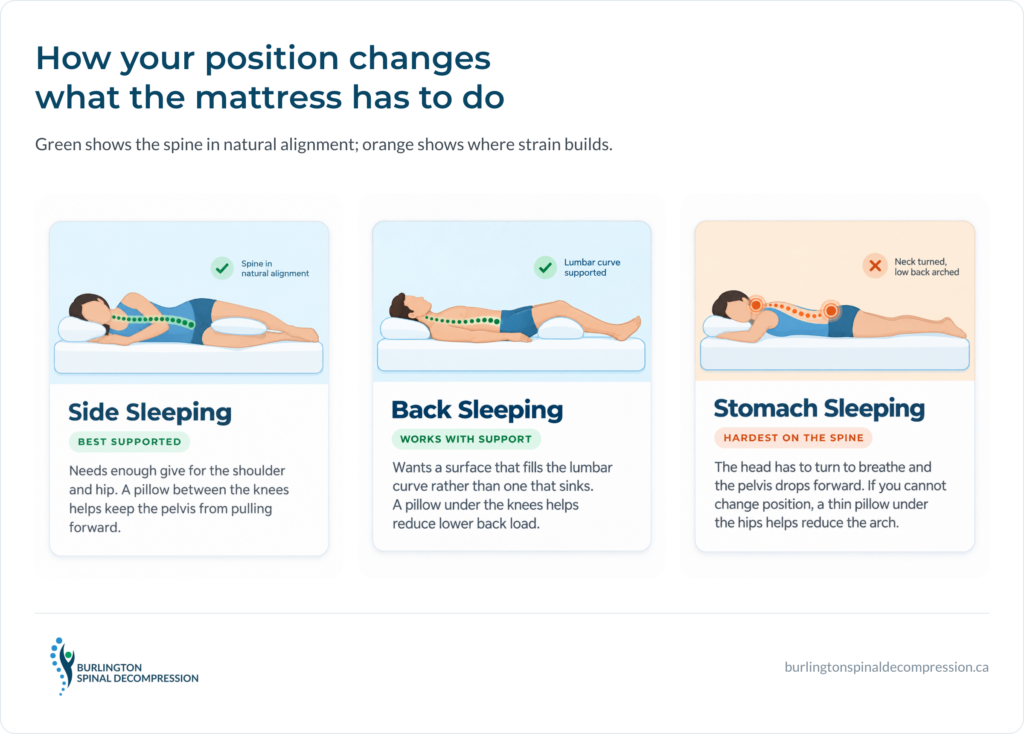
Side sleepers need more give at the hips and shoulders so those points are not jammed against a hard surface, and a firmer pillow to fill the gap between ear and mattress. Back sleepers usually want medium-firm support that keeps the lower back from arching, often with a small pillow under the knees. Stomach sleepers are the exception to the medium-firm rule and generally need something firmer, because a soft surface lets the belly sink and the lower back overarch. Most people are combination sleepers, which is one more reason to favour a surface that makes it easy to change position.
Pillows and position help you get comfortable. They are not a treatment for a disc or a nerve, so think of them as making sleep more bearable rather than fixing the underlying problem.
100% FREE DIGITAL COPY
Want to understand spinal decompression better?
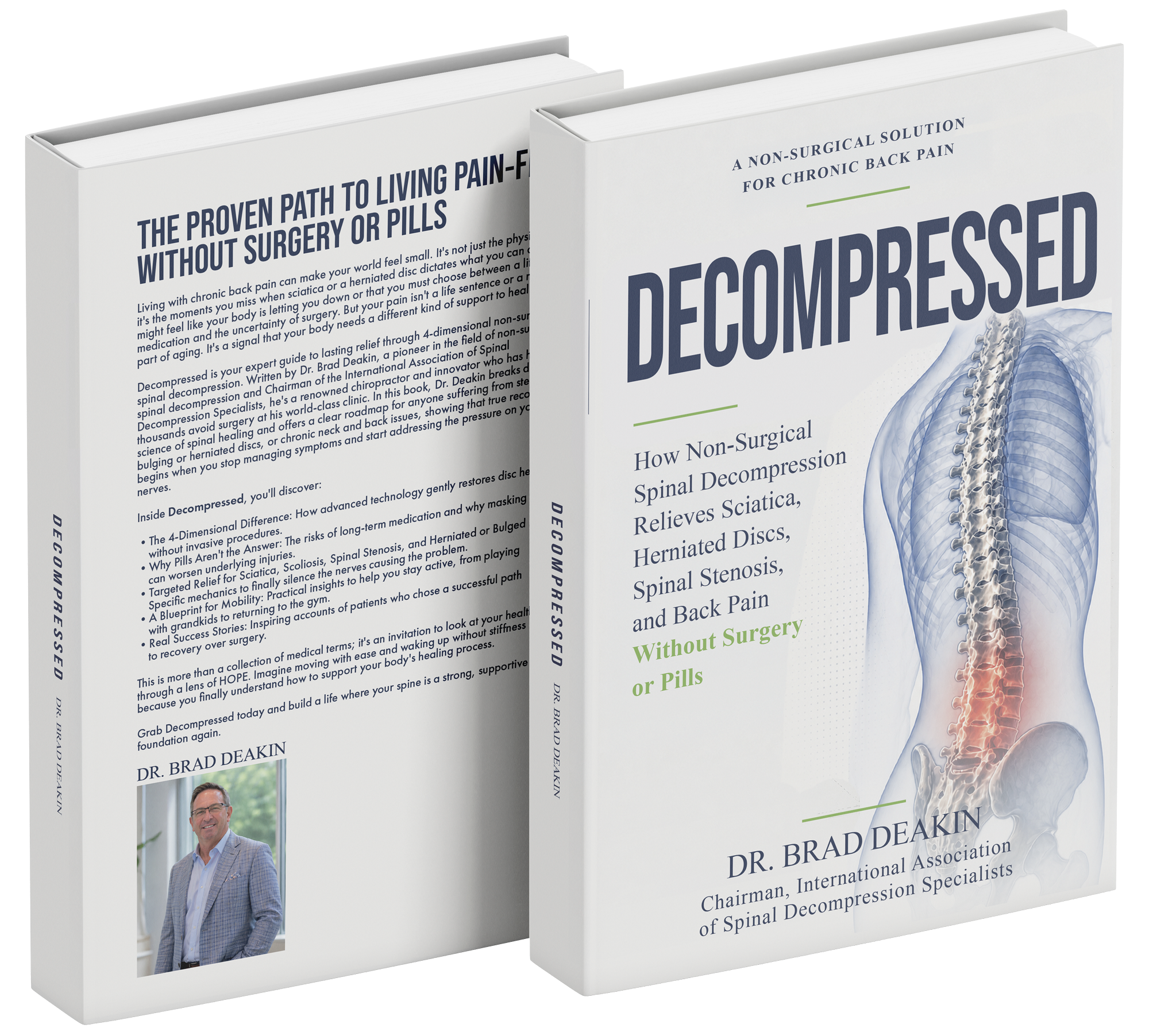
Download a 100% free digital copy of Decompressed by Dr. Brad Deakin. The book explains sciatica, herniated discs, spinal stenosis, disc-related back pain, and how spinal decompression fits into a personalized care plan.
Get Your Free Digital CopyCould your mattress be making your back pain worse?
A few patterns suggest the surface itself is worth evaluating:
- The pain is worst in bed and in the first half hour after you get up, then eases as you move.
- You cannot find a comfortable position and shift all night.
- There is a visible dip or sag, or you roll toward the middle.
- The mattress is roughly eight years old or older.
- You sleep noticeably better in a hotel or somewhere else.
Here is the important line. These patterns can tell you the sleeping surface is worth evaluating. They cannot tell you what is causing your back pain. Waking stiff from a sagging mattress and waking stiff from a compressed nerve can feel similar in bed and mean very different things.
When should you replace your mattress?
Most mattresses are worth reassessing around the seven to ten year mark, sooner if there is a visible sag, if you wake sore, or if you sleep better away from home. One useful finding from the research is that people who replaced an old, worn mattress with a newer one often reported better sleep and less pain regardless of the type they chose. Before you spend thousands, though, it is worth being honest about whether the mattress is the whole story.
Dr. Brad’s mattress shopping test
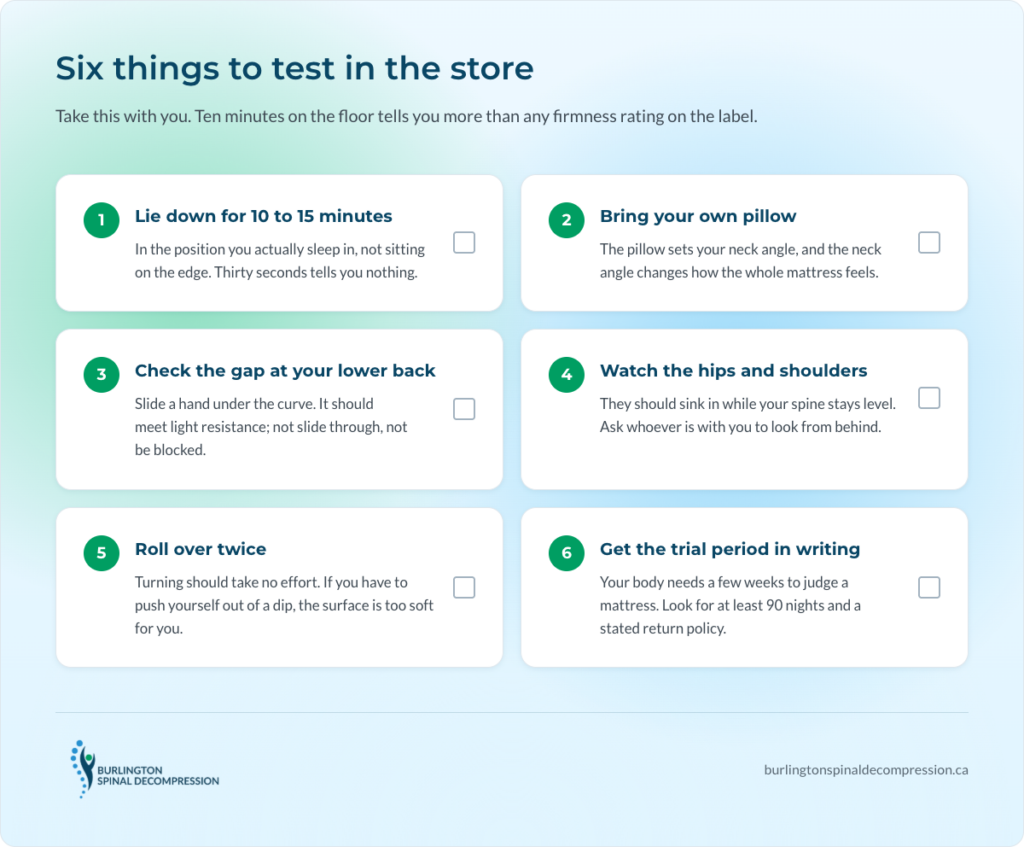
Screenshot this before you go to the store. Lie down in your actual sleeping position, not on your back for ten seconds while a salesperson talks. Then run through these:
- Can I lie in my normal sleeping position for at least five minutes and stay comfortable?
- Does my lower back feel supported, without a gap under it and without sinking into a sag?
- Are my hips and shoulders free of hard pressure points?
- Can I roll over and change position easily?
- Is there a real sleep trial, and what happens if it does not work for me at home?
- What does the warranty say about sagging and body impressions, and at what depth does it apply?
A good mattress will pass these in the showroom. A great salesperson will not rush you through them.
What a mattress cannot fix
A better mattress can make sleep more comfortable. It cannot correct a structural problem in your spine, and it should not be blamed for one either.
If your pain travels down a leg or into a foot, if you have numbness, tingling, burning or weakness, or if the pain is steadily getting worse no matter what you sleep on, that is not a mattress problem. That is a signal to understand what is happening in the spine itself. Changing beds will not settle a nerve that is being compressed.
And a short but important safety note. Seek urgent medical care right away for new loss of bladder or bowel control, numbness around the groin or saddle area, rapidly worsening weakness, or severe pain after a fall or accident. Those are not things to sleep on.
Frequently Asked Questions
For most people with chronic low back pain, medium-firm is the best starting point. Research has repeatedly found it outperforms very firm surfaces for pain and sleep. Firmness is still partly personal, and stomach sleepers and heavier sleepers often need something firmer.
Memory foam can be good for back pain because it relieves pressure and contours to the body, which suits side sleepers and couples. It can sleep warm and make moving harder. What matters is that it supports your spine in a neutral line, not the material itself.
There is no single best mattress for sciatica. Prioritize medium-firm support that keeps your spine neutral and takes pressure off the side you sleep on. Many people are most comfortable on their side with a pillow between the knees.
A mattress can contribute to back pain, especially if it is old, sagging, or wrong for your body and position. If pain is worst in bed and eases once you are up and moving, the surface is worth evaluating. It cannot tell you the underlying cause though.
A very firm mattress is not automatically best for a herniated disc. Prioritize even, consistent support that stops your lower back sagging into an arch overnight. Medium-firm support with good pressure distribution is usually the more comfortable place to start.
Reassess most mattresses around seven to ten years, sooner if there is a visible sag, you wake sore, or you sleep better elsewhere. Replacing an old, worn mattress with a newer one has been linked to better reported sleep and less pain.
An adjustable base can improve comfort for some people, particularly those with spinal stenosis who feel better with the knees raised and the lower back slightly rounded. It changes your position, not the underlying cause of the pain.
A topper can adjust the feel of a mattress that is close to right but slightly too firm, and it is far cheaper than replacing the bed. It will not rescue a mattress that is sagging or genuinely worn out. On a broken-down mattress, a topper mostly delays the inevitable.
If you have changed your pillow, adjusted how you sleep, even replaced the mattress, and you are still waking up in pain, the answer is probably not in the bedroom. It is worth understanding what is happening beyond the mattress.
At Burlington Spinal Decompression, Dr. Brad Deakin looks at how your spine is moving, your symptoms, your history and any imaging you have, and builds a personalized care plan around what he finds. We focus on disc-related pain, sciatica, spinal stenosis, degenerative disc disease and adult scoliosis, and we see patients from Burlington, Oakville, Hamilton, Milton, Waterdown and across the Halton Region.
The current new patient special is a $99 initial exam, regularly $300 Find out what is happening beyond the mattress.
Or call the clinic at (289) 337-9969.
Serving Burlington, Oakville, Hamilton, Milton, Waterdown, and the Halton region.
References
Kovacs FM, Abraira V, Pena A, et al. Effect of firmness of mattress on chronic non-specific low-back pain: randomised, double-blind, controlled, multicentre trial. The Lancet. 2003;362(9396):1599-1604. https://pubmed.ncbi.nlm.nih.gov/14630439/
Radwan A, Fess P, James D, et al. Effect of different mattress designs on promoting sleep quality, pain reduction, and spinal alignment in adults with or without back pain: systematic review of controlled trials. Sleep Health. 2015;1(4):257-267. https://www.sleephealthjournal.org/article/S2352-7218(15)00140-0/abstract
Caggiari G, Talesa GR, Toro G, et al. What type of mattress should be chosen to avoid back pain and improve sleep quality? Review of the literature. Journal of Orthopaedics and Traumatology. 2021;22(1):51. https://www.ncbi.nlm.nih.gov/pmc/articles/PMC8655046/

