

Nobody warned you that the hardest part would be the waiting for an MRI.
You finally got someone to take it seriously. You got the referral. The MRI is booked, and it’s months out. And in the meantime, every one of those days still has to be gotten through.
So you get through them. You shift in your chair every ten minutes and hope the meeting ends. You take the highway to Hamilton and twenty minutes in, the burning starts down the back of your leg, and you spend the rest of the drive trying to find an angle that helps. You’ve got a system for getting out of the car now. You’ve got a system for putting on socks.
You’re not in the emergency room. That’s the strange part. You’re not doubled over. You’ve just been quietly losing pieces of your life to this for a year, or two, or five, and the only instruction anybody has given you is to wait for the scan.
Here’s what nobody tells you: waiting for an MRI doesn’t mean waiting without a plan.
Your MRI may be months away. Your next step doesn’t have to be.
An MRI is a photograph. It isn't a plan.
An MRI is a genuinely useful thing. It’s also a picture of your spine lying perfectly still in a tube for twenty minutes.
That’s not where your pain lives. Your pain lives at minute twenty of the commute. It lives in the third hour at your desk, in the moment you reach into the back seat, in the specific way your leg goes numb when you stand at the kitchen counter. An MRI can’t see any of that, because none of it happens while you’re lying still.
This matters more than it sounds like it does. Plenty of people get the scan back, get handed a report full of words like protrusion and foraminal narrowing, and still have no idea what to actually do on Monday morning. The image showed the structure. It didn’t explain the symptom.
An MRI tells you what your spine looks like. It doesn’t tell you what your spine is doing to your life, and it doesn’t tell you what to do about it.
An assessment answers the second question. And you don’t need the first one finished to start.
What We Look at While You're Waiting for an MRI
Your first visit at Burlington Spinal Decompression is a detailed spinal assessment. Dr. Brad goes through:
- Where the pain starts, and where it goes
- Whether it travels into the thigh, the calf, the foot, and how far down
- Numbness, tingling, burning or weakness, and when each one shows up
- The movements and positions that set it off, and the ones that give you relief
- How your spine actually moves
- Nerve and muscle function, measured with an EMG scan
- Infrared thermography, which maps how your nervous system is behaving
- Digital X-rays taken on site, where they’re clinically appropriate
- Any X-rays, MRI reports or PocketHealth images you already have
- What you’ve already tried, and why the relief didn’t hold
- What this has cost you at work, in your sleep, and on the weekend
That last one isn’t a soft question. If you’ve stopped playing pickleball on Thursdays, that’s a clinical finding. It tells us what the nerve is doing under load and it tells us what we’re aiming at.
A spinal assessment doesn’t replace an MRI your physician ordered, and we wouldn’t want it to. They’re different tools answering different questions. The scan shows structure. The assessment shows what that structure is doing to the way you move, the way your nerves fire, and the way your Tuesday goes.
Do you need the MRI before you book? No.
You don’t have to wait on imaging to get assessed. A lot of our patients come in with the scan still months away, and a lot come in having never been sent for one.
Dr. Brad starts with your history, your symptoms, the physical findings and whatever imaging you’ve already got. If more imaging or medical follow-up is needed, that becomes part of the conversation rather than a reason to send you back to the waiting room for another season.
The point of the initial exam isn’t to guess ahead of your scan. It’s to gather enough information to see your case clearly, so that when the MRI does come back, you’re not starting from zero. You’re confirming something you already understand.
Signs your Back Pain involves a Disc or a Spinal Nerve
Not all back pain is the same problem, and the difference is usually in how you’d describe it to someone. A few patterns come up over and over in this clinic.
The pain travels down one leg
It starts in the lower back or the buttock and runs into the thigh, the calf or the foot. Patients almost always draw it as a line, not an area. That’s a nerve. Muscles ache in regions. Nerves complain in lines.
Numbness or Tingling
Pins and needles in the leg, the toes or the foot. It comes and goes. It’s often worse in the morning or after you’ve been sitting.
Burning or Electric Pain
Burning, sharp, electric. People use different words for this than they use for a pulled muscle, and they use them without prompting. Dull and achy is one thing. Electric is another.
It’s worse sitting than standing
Sitting puts more load through the disc than standing does. If twenty minutes in a chair is worse than twenty minutes on your feet, that’s telling you something about where the problem is.
Walking or standing has become difficult
You find yourself leaning on the shopping cart. You plan your route around places to sit. Spinal stenosis and nerve compression both do this.
It’s taking your sleep
You can’t find a position. You wake up at 3am and go looking for one. You’re stiff for the first half hour of the day, every day. Exhaustion is doing as much damage at this point as the pain is.
If two or more of these sound like you, this is very likely a structural problem, and structural problems respond to structural care.
Your pain has already taken enough of your time. Start with a detailed assessment.
Where Spinal Decompression fits
If the assessment points to a disc or a nerve, decompression is what we do about it.
Our 4D decompression technology applies controlled traction at a specific spinal level, at a specific angle, with lateral flexion and axial rotation.
That last part is the part that matters, and it’s the part most tables can’t do.
Think about it this way. A standard decompression table pulls in one straight line. That’s fine if you have a textbook spine. You probably don’t. If your spine has a curve, a rotation, or a disc that herniated off to one side, a single straight line of pull is working around your anatomy instead of with it. The 4D system lets us match the pull to the spine you actually have, including adult scoliosis, which is a big part of why we can treat cases that get turned away elsewhere.
Taking pressure off the disc space takes load off the irritated nerve. Less load on the nerve means the burning and the numbness and the leg pain have room to settle down. Then the rehabilitation side builds the support around it, so what you gain in the sessions is something you keep in your life.
Your care plan is built from your imaging, your exam findings and your goals. It isn’t a protocol somebody else got handed.
And to answer the question everyone asks in the room and nobody asks on the phone: no, it doesn’t hurt. The table applies gentle, controlled traction. There’s no cracking and no sudden force. A fair number of patients fall asleep.
Already have your MRI report or PocketHealth images?
Bring them. If your records are in PocketHealth, you can share the secure access link with the clinic before your appointment and Dr. Brad will have gone through it before you sit down.
Your report might say some of these:
- Disc protrusion
- Disc extrusion
- Foraminal narrowing
- Central canal stenosis
- Nerve-root impingement
- Degenerative disc disease
- Facet degeneration
- Spondylolisthesis
Most people read that list, look up two of the terms, get frightened by one of them, and are no closer to knowing what to do next.
Dr. Brad will put your images up and walk you through them. Not read them at you. Walk you through them, so you can see the level, see the disc, and understand why your foot goes numb when you stand at the counter. Patients tell us this is the first time anyone actually showed them.
Recommended Reading
Want to understand spinal decompression better?
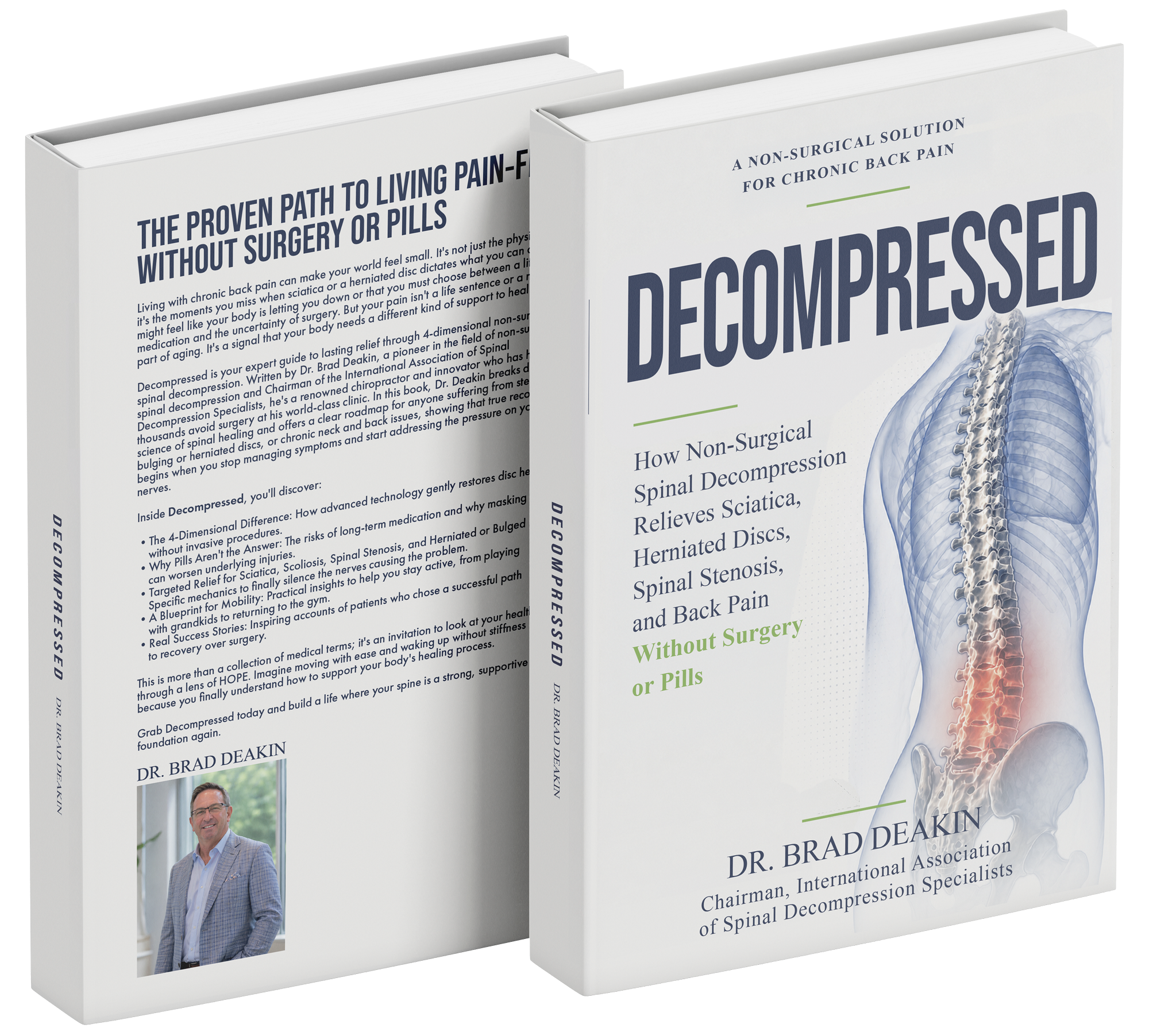
Dr. Brad Deakin’s book Decompressed explains how non-surgical spinal decompression supports people dealing with sciatica, herniated discs, spinal stenosis, and disc-related back pain.
View the Book on AmazonWhat's included in the $99 Initial Exam
Regularly $300. It’s a two-visit process, and here’s what’s in it:
- An in-depth consultation about your pain history and the care you’ve already had
- An EMG nerve and muscle scan
Infrared thermography - Digital X-rays, taken on site
- A full review of any existing X-rays or MRI information you bring
- Your Report of Findings with Dr. Brad, where you see your own images and get the explanation
- Your personalized care plan
- Most people read that list, look up two of the terms, get frightened by one of them, and are no closer to knowing what to do next.
You’ll leave the second visit knowing what’s happening in your spine and what the plan is. That’s the whole point of it.
Patients come to us from across Halton and Hamilton
Burlington Spinal Decompression is on Fairview Street in Burlington, and we see patients from Burlington, Oakville, Hamilton, Milton, Waterdown and the surrounding Halton communities. Disc-related pain, sciatica, spinal stenosis, degenerative disc disease, adult scoliosis and radiating nerve symptoms are what this clinic does. It’s not one service on a long list. It’s the whole practice.
A lot of the people who find us are golfers, weekend soccer players and pickleball regulars who’ve had to stop, and commuters on the Burlington and Hamilton corridor whose worst hour of the day is the one spent in the car.
When Back Pain needs immediate medical attention
Get urgent medical care right away for any of the following: new loss of bladder or bowel control, numbness around the groin or saddle area, weakness that’s rapidly getting worse, major trauma, or a fever alongside severe back pain.
Burlington Spinal Decompression doesn’t provide emergency care. If that’s what’s happening, go now.
Frequently Asked Questions
No. We don’t provide MRI scans and we don’t have any influence over hospital imaging schedules. What we provide is a detailed spinal assessment and a personalized care plan for back pain, sciatica and disc or nerve-related symptoms, so that the wait isn’t wasted.
Write down your symptoms while they’re fresh, including what triggers them and what helps. Follow the instructions from whoever ordered the imaging. Gather any existing reports. And book a detailed spinal assessment so you’re working with information instead of guessing.
Not always. Dr. Brad reviews your symptoms, examination findings, previous care and available imaging, and that’s what determines the next step.
Yes. Bring the report and the images to your initial exam and Dr. Brad will go through them with you alongside your symptoms and clinical findings. We’re not a radiology service and we don’t replace the radiologist’s formal report.
The nerve running from your lower back into your leg produces pain, numbness, tingling or burning anywhere along its path. So the symptom shows up in your calf while the cause sits in your spine. Treating the calf gets you nowhere. That’s why the leg pain never resolves with massage or stretching.
$99, regularly $300. That covers the consultation, the diagnostic scans, digital X-rays, imaging review and your Report of Findings.
3350 Fairview Street, Unit 1, Burlington, Ontario L7N 3L5. We see patients from Burlington, Oakville, Hamilton, Milton, Waterdown and across the Halton Region.
References
Adult degenerative scoliosis, prevalence and progression (AAPM&R, PM&R KnowledgeNow): https://now.aapmr.org/scoliosis/
Degenerative scoliosis: a review (HSS Journal, via NIH): https://pmc.ncbi.nlm.nih.gov/articles/PMC3192887/
Stop waiting without a plan. Book your $99 initial exam at Burlington Spinal Decompression.
Book your $99 initial exam today. Your visit includes a full consultation, nerve scans, digital X-rays, a review of your imaging, and a complete report of findings. No obligation to continue.
Or call the clinic at (289) 337-9969.gener
Serving Burlington, Oakville, Hamilton, Milton, Waterdown, and the Halton region.
References
American College of Radiology. (2021). ACR Appropriateness Criteria®: Low back pain. https://acsearch.acr.org/docs/69483/narrative/
Deakin, B. (2026). Decompressed: How non-surgical spinal decompression relieves sciatica, herniated discs, spinal stenosis, and back pain without surgery or pills. https://www.amazon.ca/dp/1835566790
Gose, E. E., Naguszewski, W. K., & Naguszewski, R. K. (1998). Vertebral axial decompression therapy for pain associated with herniated or degenerated discs or facet syndrome: An outcome study. Neurological Research, 20(3), 186–190. https://pubmed.ncbi.nlm.nih.gov/9583577/
Ontario Health. (n.d.). Wait times: Diagnostic imaging, surgeries and procedures in Ontario. https://www.ontariohealth.ca/system/reporting/wait-times.html
PocketHealth. (n.d.). How to share your medical imaging records securely with multiple providers. https://www.pockethealth.com/patient-resources/sharing-medical-imaging-with-multiple-providers/

